
UK Short-Term Rental Market Trends 2025: Demand, Booking Behaviour, and What STR Operators Must Prepare for in 2026
The UK short-term rental market in 2025 did not suffer a demand collapse; it experienced a structural shift in guest behaviour. Guests searched earlier, booked later, stayed for fewer nights, and concentrated demand into narrower booking windows. For STR operators and property management companies, this distinction is critical. Misreading behaviour as “weaker demand” leads to pricing mistakes, poor calendar control, and missed revenue. This analysis draws on UK-wide search and booking data from Beyond, comparing 2024 and 2025 performance and outlining what these signals mean for 2026 planning.
UK STR Demand in 2025, Search Activity Led the Market
Search behaviour moved before bookings, and it moved faster. Early in 2025, UK guest search volume accelerated ahead of 2024 levels. Guests were actively researching trips earlier in the year, with stronger intent and higher frequency. This search momentum proved to be a leading indicator of summer performance.
Key demand signals in 2025:
Summer stay searches peaked roughly 3 weeks before booking
Booking pace increased 18% year on year
By August, average lead times compressed to approximately 7 days
For STR operators, the implication is straightforward. By the time bookings appear in the system, the demand signal has already passed. Pricing and availability decisions that wait for confirmed bookings are already reacting too late.

Booking Lead Times Shortened Across the UK
One of the most important short-term rental trends in 2025 was lead-time compression.
Across the UK market:
Short-lead intent, under 2 weeks, increased by 6 points year on year
Average planning windows shortened by 9 days compared to 2024
Late-booking behaviour became the dominant pattern, not an edge case
This shift reduces reaction time for operators. Pricing, LOS rules, and gap management now need to function effectively much closer to arrival. Static pricing strategies and infrequent calendar reviews increasingly underperformed in this environment.
Shorter Planning Windows Changed Length of Stay Patterns
As booking windows tightened, trip behaviour adjusted.
UK short-term rental data shows:
3–4 night stays increased by 4 points year on year
Longer stays declined by 3 points
Short breaks now account for roughly one-third of all UK STR stays
Guests are not travelling less; they are travelling more often and for shorter durations.
Operators who continued to prioritise longer LOS restrictions often created unfilled gaps and missed high-intent short-stay demand.
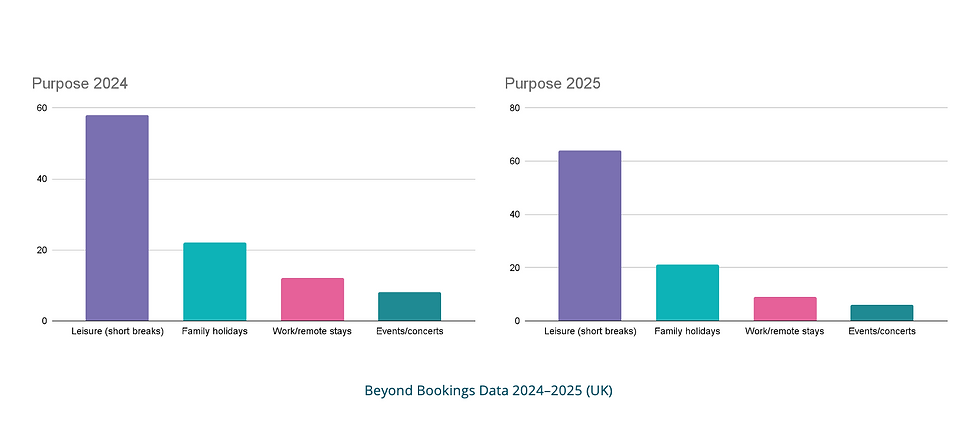
Where UK STR Demand Came From in 2025
Search data also highlights who drove demand, not just when it occurred.
Two demand segments played a critical role:
High-value US travellers returning to the UK market
Stable European leisure demand providing consistent baseline volume
This matters for pricing and distribution strategy. Markets aligned to international demand were better positioned to hold rates during peak periods, while markets pricing purely for domestic assumptions often under-captured value.

Regional STR Performance Across the UK
2025 performance varied meaningfully by destination type.
Urban Short-Term Rental Markets
Strong performance driven by pace and proximity
Smaller units outperformed larger inventory
Short stays and late bookings dominated demand
Coastal Short-Term Rental Markets
ADR generally held year on year
Longer stays softened
Smaller, premium properties outperformed larger family homes
Rural Short-Term Rental Markets
Occupancy softened, particularly for larger properties
Group booking pace lagged behind other regions
Value perception became more important than availability
These are not temporary fluctuations; they reflect structural differences that require region-specific pricing, LOS rules, and channel strategies.

Length of Stay Trends Continue to Evolve
The shift toward shorter stays did not stabilise in 2025; it accelerated. Urban and coastal markets led the transition, while rural destinations showed slower adjustment. However, no region remained unaffected, which reinforces a key revenue management principle for STR operators. Calendar control now drives revenue performance more than base ADR alone.
UK Short-Term Rental Outlook 2026, From Recovery to Readiness
The UK STR market is no longer in recovery mode. The focus for 2026 is operational readiness. 3 forces are likely to define performance.
Demand Concentration
Peak weeks will remain strong, but shoulder periods are likely to soften further.
What operators should prioritise:
Active midweek pricing strategies
Targeted promotions instead of blanket discounts
Shorter Booking Curves
Lead times are expected to shorten again as flexible planning becomes standard.
What operators should prioritise:
Short-lead pricing optimisation
Automated calendar responses to late demand
Market Divergence
Urban and coastal markets are likely to remain resilient, while rural markets recalibrate.
What operators should prioritise:
Region-specific pricing logic
Diversified channel mix by destination type

Final Insight for STR Operators and PMCs
The UK short-term rental market in 2025 did not lose demand. It compressed demand into shorter timelines. Operators who adapt pricing, LOS rules, and automation to this reality will be better positioned in 2026. Those who continue to rely on long booking curves and static assumptions will struggle to interpret performance correctly; speed now matters as much as price.


Comments